
What Glass Installation Really Means Before Anyone Touches a Panel
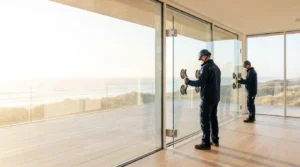
Most people picture glass installation as one simple act, someone shows up, lifts a panel, and screws it into place. The reality has a lot more layers, and those layers are exactly what separate a shower enclosure that stays tight for fifteen years from one that starts weeping at the bottom sweep after eight months.
Professional glass installation is a sequence of decisions. What type of glass, what thickness, what edge profile, what hardware finish, what sealant chemistry, what substrate anchors into. Each choice interacts with the next one.
Here in the Grand Strand, that decision chain gets tighter. Salt air, high humidity, wind load requirements, and seasonal temperature swings all pull on the same assembly. A specification that works fine in a dry inland climate can fail early two blocks from the ocean.
So this guide walks through the whole thing. Glass types, safety standards, the actual installation sequence, coastal considerations, maintenance, and how to tell a real glazier from someone with a van and a suction cup.
Glazing, Glass Installation, and Glass Replacement Are Not Synonyms
These three terms get used interchangeably, and that causes confusion when homeowners request quotes. Getting the vocabulary right helps you describe what you actually need.
Glazing is the trade itself, the craft of fitting glass into an opening or frame. It covers the whole discipline, including sealant work, setting blocks, gasket selection, and structural attachment.
Glass installation is the act of putting new glass into a space, whether that space previously had glass or not. A new frameless shower enclosure in a bathroom remodel is an installation. So is a first-time glass railing on a rear deck.
Glass replacement is a subset of installation where existing glass comes out and new glass goes in. The opening already exists, the frame may or may not stay, and the work often involves diagnosing why the original unit failed.
Knowing the distinction matters because the scope of work, the field measuring approach, and the prep requirements differ. Replacement work carries hidden variables, old frames hide rot, corroded fasteners, and out-of-square openings that only reveal themselves after demolition.
Who Actually Performs Professional Glass Work
A qualified glass contractor is not a general handyman. The trade requires knowledge of load calculations, safety glazing regulations, sealant compatibility, and fabrication tolerances measured in sixteenths of an inch.
A working glazier understands why a 3/8 inch tempered panel needs different hardware than a 1/2 inch panel, why silicone cannot bond to certain powder-coated finishes, and why a mirror in a steam room needs a different backing than one over a vanity.
They also carry the insurance that matters. Glass is heavy, sharp, and unforgiving. A 1/2 inch tempered shower panel at 36 by 76 inches weighs well over a hundred pounds. Handling that without proper equipment is how people get hurt and how property gets damaged.
Licensing and insurance verification is not paperwork theater. In South Carolina and North Carolina, working with a licensed and insured glass company protects you if something breaks during installation or fails structurally later.
Types of Glass Used in Residential and Commercial Glass Installation
Glass is not one material. It is a family of engineered products with wildly different behavior under stress, heat, and impact. Choosing wrong is the single most common cause of premature failure.
Annealed Glass and Where It Still Belongs
Annealed glass is float glass cooled slowly during manufacturing. It has no added strength treatment, and when it breaks, it produces long, sharp shards. That breakage pattern is why building codes restrict where it can go.
It still has legitimate uses. Picture framing, some cabinet doors, decorative panels in non-hazardous locations, and interior applications where impact risk is minimal. It also cuts and edges cleanly on site, which tempered glass does not.
The critical rule: annealed glass cannot be modified after tempering because it was never tempered. That sounds obvious, but it is the flip side of the constraint that shapes every tempered project.
Tempered Glass, the Workhorse of Modern Installation
Tempered glass, also called toughened glass, goes through a controlled heating and rapid cooling cycle that puts the surfaces in compression and the core in tension. The result is roughly four to five times stronger than annealed glass of the same thickness.
When tempered glass fails, it fragments into small, relatively dull pieces instead of dagger shards. That behavior is what qualifies it as safety glazing under CPSC 16 CFR 1201 and ANSI Z97.1.
Here is the constraint that surprises homeowners: tempered glass cannot be cut, drilled, notched, or edge-worked after tempering. Every hole for a hinge, every notch for a handle, every cutout for a fixture must be fabricated before the glass enters the tempering oven.
This is precisely why field measuring matters so much. A quarter inch error on a shower door means the entire panel gets refabricated, not adjusted. There is no trimming a tempered panel to fit.
Laminated Glass and Impact Performance
Laminated glass bonds two or more glass plies to an interlayer, typically polyvinyl butyral (PVB) or SentryGlas style ionoplast. When the glass cracks, the interlayer holds the fragments in place.
That retention behavior gives laminated glass three advantages. It resists penetration, it maintains a barrier after breakage, and it dampens sound transmission better than monolithic glass of comparable thickness.
For coastal work, laminated glass is central to impact-resistant glazing. Assemblies rated for windborne debris zones almost always use laminated construction, sometimes laminated and heat-strengthened together.
It also blocks the overwhelming majority of UV transmission, which matters for protecting flooring, artwork, and upholstery from fading in sun-heavy rooms.
Insulated Glass Units and Thermal Performance
An insulated glass unit (IGU) is two or more panes separated by a spacer and sealed around the perimeter, with the cavity filled with air or an inert gas like argon or krypton. The cavity does the insulating work.
Modern IGUs use warm-edge spacers to reduce thermal bridging at the perimeter, plus a desiccant inside the spacer to absorb residual moisture. When that desiccant saturates or the seal fails, you get the classic foggy window.
The performance numbers to know are U-factor, which measures heat transfer (lower is better), and solar heat gain coefficient (SHGC), which measures how much solar radiation passes through. In a cooling-dominated climate like coastal South Carolina, a low SHGC often matters more than a low U-factor.
Visible transmittance (VT) rounds out the picture, telling you how much daylight comes through. NFRC labels on new units list all three, which makes comparison shopping possible without guesswork.
Low-E Coatings and Specialty Glass
Low-emissivity (Low-E) glass carries a microscopically thin metallic oxide coating that reflects infrared while letting visible light through. Manufacturers like Guardian, Vitro, and Cardinal produce coating families tuned for different climates.
Coating placement matters. A coating on surface two behaves differently than one on surface three, and in a hot, humid region the goal is usually rejecting solar heat before it enters the cavity.
Beyond Low-E, the specialty catalog includes frosted and acid-etched glass for privacy, rain glass and other patterned textures, tinted glass in bronze and gray, back-painted glass for splash applications, and low-iron glass for near-perfect clarity where a green edge tint would be visible.
Low-iron glass, sometimes sold as ultra-clear, is the standard choice for frameless shower enclosures and glass railings where the edge is exposed and the color cast would be noticeable.
| Glass Type | Key Strength | Breakage Behavior | Typical Applications | Can Be Cut On Site |
|---|---|---|---|---|
| Annealed | Easy to fabricate on site | Long sharp shards | Cabinet doors, frames, decorative panels | Yes |
| Heat-Strengthened | About twice annealed strength | Large fragments | Spandrel glass, some laminated builds | No |
| Tempered | 4x to 5x annealed strength | Small dull fragments | Shower doors, railings, tabletops, entry glass | No |
| Laminated | Retains fragments after break | Cracks but holds together | Impact zones, skylights, sound control, security | No |
| Insulated Unit | Thermal separation | Depends on plies used | Windows, storefronts, curtain wall | No |
| Low-Iron | Near-colorless clarity | Depends on treatment | Frameless enclosures, railings, display cases | No |
Residential Glass Installation, Space by Space
Residential work covers a broader product range than most people expect. The same crew that installs a shower enclosure on Monday may set a glass railing on Tuesday and template a dining table top on Wednesday.
Shower Doors and Bathroom Glass Enclosures
Shower glass is the highest-visibility residential category and the least forgiving. Bathrooms are rarely square, walls are rarely plumb, and tile surfaces introduce their own tolerance stack.
A frameless shower door uses thick tempered glass, usually 3/8 or 1/2 inch, with minimal metal. The glass itself carries the load through wall-mounted hinges and clamps. It looks clean and it shows every millimeter of a bad measurement.
A semi-frameless enclosure frames the perimeter but leaves the door edge free, using thinner glass and reducing the precision demand slightly. A framed enclosure surrounds all edges in metal, uses thinner glass, and tolerates more variance in the opening.
Steam shower enclosures add a layer. They need a transom or vent at the top, sealed perimeter joints, and glass and hardware rated for continuous humidity and heat cycling.
Homeowners planning a bathroom project often find that Glass Installation in Carolina Forest, SC and similar newer-construction areas involves tighter tolerances, because modern tile layouts leave less margin for shimming than older builds do.
What Actually Drives Shower Enclosure Longevity
Three variables dominate. Hardware quality, sealant execution, and glass surface treatment.
Hardware from established manufacturers such as CR Laurence or comparable lines uses corrosion-resistant substrates under the finish, not just a plated coating over soft metal. In salt-air conditions, that substrate choice determines whether hinges look good in year five.
Sealant execution means the right chemistry in the right joints, and critically, the right joints left open. Water needs a path out. Sealing every seam traps moisture inside the assembly instead of draining it.
Surface treatment, sometimes marketed as easy-clean or hydrophobic coating, fills the microscopic pores in the glass surface so mineral deposits have less to grab. It reduces cleaning effort, it does not eliminate cleaning.
Mirrors, From Vanity to Full Wall
Mirror installation looks simple until you consider substrate, adhesive, moisture, and edge treatment. A custom mirror in a powder room and a gym mirror wall are different engineering problems.
Safety-backed mirror carries a film on the back that holds fragments if the mirror breaks. For home gyms, commercial fitness spaces, and anywhere a mirror sits near activity, that backing is the responsible specification.
Adhesive selection matters more than most people realize. Standard construction adhesives can attack the silver backing on a mirror and cause black edge, a creeping dark discoloration that starts at the perimeter and works inward.
Edge profiles include flat polish, pencil polish, beveled, and various decorative options. Beveled edges add depth and catch light, and they also add fabrication time and require slightly larger clearances.
Glass Table Tops and Furniture Glass
A glass table top is a deceptively technical product. Thickness selection depends on span, support layout, and expected load. Edge profile depends on aesthetics and safety.
Most dining applications use tempered glass at 3/8 or 1/2 inch, with polished edges and radiused corners. Protective pads or bumpers keep the glass from sliding and prevent point loading against a hard base.
Templating is standard practice for anything non-rectangular. A paper or plastic template captures the true shape, including any irregularity in the base or the intended overhang.
Glass Railings, Staircases, and Balustrades
Glass railings and glass balustrades turn a safety requirement into an architectural feature, and they carry the most demanding structural requirements in residential glass work.
Guard systems must resist specified loads, typically a concentrated load and a uniform load applied at the top rail, plus an infill load on the panel itself. Those requirements come from the building code and they are not negotiable.
Attachment methods include base shoe channels grouted or dry-glazed, standoff or point-fixed hardware, and spigot posts. Each transfers load differently, and each requires a substrate capable of taking that load.
Glass staircases and glass treads add slip-resistance requirements to the mix, usually addressed with laminated construction and a textured or ceramic-frit top surface.
For elevated coastal decks, where wind load combines with guard load, laminated construction is common. Properties requesting Glass Installation in Garden City, SC frequently involve raised oceanfront decks where that combination governs the specification.
Splash Panels, Back-Painted Glass, and Wet Panels
A splash panel or wet panel protects a wall surface from water and steam, typically behind a sink, a range, or a tub deck. It is a seamless, non-porous alternative to tile.
Back-painted glass, sometimes called back-lacquered or painted glass splashback, gets its color from a coating applied to the rear surface. The color reads through the glass with depth that paint alone cannot match.
Behind a cooking surface, heat resistance matters, which usually means tempered glass and adequate clearance from the burners per the appliance manufacturer’s requirements.
Cutouts for outlets, switches, and fixtures must be located precisely and fabricated before tempering. This is another place where a careful field measure prevents an expensive refabrication.
Commercial Glass Installation and Architectural Glazing
Commercial work operates under different pressures. Occupancy requirements, accessibility standards, business continuity, and inspection schedules all shape how the job runs.
Storefront Glass and Entrance Systems
Storefront glass systems use aluminum framing, typically from extrusion lines like Kawneer, YKK AP, or Tubelite, with glass set into pockets using gaskets or wet-sealed with structural silicone.
Two glazing philosophies exist. Dry glazing uses preformed gaskets to hold and seal the glass. Wet glazing uses sealant applied in place. Many systems combine both, dry on the interior and wet on the exterior.
Water management inside a storefront frame is deliberate. Sill pans, weep holes, and internal drainage channels move incidental water back outside. Blocking those weeps during installation causes leaks that look like glass failure but are actually drainage failure.
For a retail tenant, downtime is the real cost driver. Temporary boarding, off-hours scheduling, and staged installation keep doors open while work proceeds.
Commercial Glass Doors and Accessibility Requirements
Commercial glass doors carry accessibility obligations. Opening force limits, hardware height and operability, maneuvering clearances, and closing speed all fall under ADA standards.
Lever handles and push-pull hardware satisfy the requirement that operation not demand tight grasping, pinching, or wrist twisting. Round knobs generally do not.
Closer adjustment is where compliance frequently drifts. A door adjusted for a tight seal in winter may exceed opening force limits, and a closer sweep period that is too fast fails the timing requirement.
All-glass entrances using patch fittings and floor closers deliver a high-end look, and they demand precise floor preparation and a substrate that can accept the closer housing.
Office Partitions and Interior Glazing
Glass partitions and glass office fronts have become standard in modern workplace design, delivering daylight penetration and visual openness while keeping acoustic separation.
Acoustic performance depends on glass thickness, air gap, perimeter sealing, and whether the partition runs to the deck or stops at a ceiling grid. A partition that stops at the grid leaks sound over the top regardless of glass specification.
Switchable privacy glass and applied films offer on-demand opacity for conference rooms. Both require power and control planning coordinated with the electrical trade before framing closes.
Firms specifying interior glazing for medical or professional offices near Glass Installation in Florence, SC often prioritize acoustic ratings alongside appearance, since patient and client privacy is a functional requirement rather than a preference.
Safety Glazing in Commercial Environments
Commercial occupancies expand the list of locations requiring safety glazing. Doors, sidelites, glazing near walking surfaces, glazing in wet areas, guards, and large panels near floor level all trigger requirements.
Every piece of safety glazing must carry a permanent identifying mark showing the fabricator, the standard it meets, and the type. That mark is what an inspector looks for, and it cannot be added later.
Fire-rated glazing is its own category with its own product families and its own testing standards. It is specified by rating and assembly, not selected by appearance.
Why the Coastline Changes Every Glass Installation Decision
Working along the Grand Strand is not the same as working two hundred miles inland. The environment applies constant, cumulative stress to materials that would last decades elsewhere.
Salt Air Corrosion and Hardware Selection
Airborne salt reaches surprisingly far inland and settles on every exposed surface. On metal hardware, that salt film holds moisture against the finish and drives galvanic and pitting corrosion.
The defense is material selection, not just finish selection. 316 stainless steel outperforms 304 in marine exposure. Solid brass with quality plating outperforms zinc alloy with the same plating.
Finish choice contributes too. PVD (physical vapor deposition) coatings bond at a molecular level and resist salt exposure far better than conventional electroplating, which is why they are worth specifying on oceanfront projects.
Homeowners in areas like Glass Installation in North Myrtle Beach, SC and Glass Installation in Briarcliffe Acres, SC benefit most from marine-grade specifications, because proximity to open water accelerates every corrosion mechanism.
Rinse maintenance closes the loop. Fresh water rinsing of exposed hardware, especially after storms, removes the salt film before it can do sustained damage.
Wind Load, Impact Resistance, and Storm Season
Coastal building requirements address two separate threats, sustained wind pressure and windborne debris impact. A product can handle one without handling the other.
Design pressure (DP) ratings describe how much positive and negative pressure an assembly can take. Impact ratings describe whether it survives a projectile strike followed by pressure cycling.
Impact-resistant glass assemblies use laminated construction, reinforced framing, and specific anchor patterns. The whole assembly is tested and rated together, so substituting a component invalidates the rating.
Properties in Glass Installation in Surfside Beach, SC and Glass Installation in Murrells Inlet, SC sit in zones where those ratings become part of the permitting conversation rather than an optional upgrade.
Preparation before storm season is practical work. Verify that operable units latch fully, confirm that sealant joints have not opened, and inspect anchors on any exterior glass guard.
Humidity, Thermal Cycling, and Seal Failure
High ambient humidity does two things. It gives condensation more opportunity to form on cool surfaces, and it accelerates any process that needs moisture to proceed.
Thermal cycling matters just as much. A dark-framed unit in direct afternoon sun can reach surface temperatures far above ambient, then drop quickly during a summer thunderstorm. That expansion and contraction works the perimeter seal on every cycle.
Thermal stress breakage happens when part of a pane heats significantly while another part stays cool, often due to partial shading or an interior object trapping heat against the glass. Heat-strengthened or tempered glass tolerates that differential better than annealed.
Seal failure in an IGU shows up as haze, streaking, or visible moisture between panes. Once the perimeter seal is compromised, the unit cannot be restored to original performance, and replacement is the honest answer.
| Coastal Factor | Primary Effect on Glass Assemblies | Specification Response |
|---|---|---|
| Salt aerosol | Hardware corrosion, finish pitting | 316 stainless, solid brass, PVD finishes |
| Windborne debris | Panel penetration, breach of envelope | Laminated impact-rated assemblies |
| Sustained wind pressure | Deflection, anchor stress, seal working | Verified design pressure rating, engineered anchors |
| High humidity | Condensation, accelerated corrosion | Proper drainage, ventilation, moisture-tolerant backing |
| UV intensity | Interior fading, sealant degradation | Low-E coatings, laminated interlayers, UV-stable sealants |
| Thermal cycling | Seal fatigue, thermal stress breakage | Heat-strengthened or tempered glass, warm-edge spacers |
Where the Rules Come From: Codes, Standards, and Permits
Glass is one of the more heavily regulated materials in construction, and for good reason. The standards exist because people were getting seriously injured by ordinary glass in ordinary places.
ANSI Z97.1 and CPSC 16 CFR 1201
ANSI Z97.1 is the voluntary consensus standard for safety glazing in buildings, defining impact test methods and classification levels. CPSC 16 CFR 1201 is the federal regulation covering architectural glazing materials.
Both establish impact performance thresholds. Category I and Category II designations correspond to different drop heights and different permitted glazing areas, with Category II being the more demanding classification.
The practical takeaway for a homeowner is simple. Safety glazing carries a permanent mark, that mark references these standards, and glass without it does not belong in a regulated location.
Hazardous Locations Under the Residential and Building Codes
The International Residential Code (IRC) and International Building Code (IBC) define specific locations where safety glazing is mandatory. These are commonly called hazardous locations.
The list is more extensive than most people assume, and it is the reason a bathroom window near a tub gets tempered glass while an identical window in a bedroom might not.
| Hazardous Location Category | Why It Requires Safety Glazing | Common Glazing Response |
|---|---|---|
| Glazing in doors | Direct human impact risk during operation | Tempered or laminated |
| Sidelites adjacent to doors | Mistaken for opening, impact risk | Tempered or laminated |
| Glazing in wet areas near tubs and showers | Wet, slippery surfaces plus close proximity | Tempered, commonly 3/8 or 1/2 inch |
| Guards and railings | Fall protection, structural load | Laminated or tempered, load-verified |
| Large panels near floor level | Walk-into risk | Tempered or laminated |
| Glazing adjacent to stairs and landings | Fall and impact risk on changing elevation | Tempered or laminated |
Permits, Inspections, and Local Requirements in SC and NC
Whether a permit is required depends on scope and jurisdiction. Replacing a single interior mirror generally does not require one. Altering an exterior opening, installing a structural glass guard, or modifying a commercial entrance usually does.
Coastal jurisdictions add wind zone and impact requirements to the review. In some areas, product approval documentation for the specific assembly must be submitted with the application.
Cross-state work introduces another layer. A glass company serving both South Carolina and North Carolina has to work fluently within two code adoption timelines and two sets of local amendments.
Property owners scheduling Glass Installation in Georgetown, SC or Glass Installation in Little River, SC often encounter different documentation expectations than owners a few miles away, simply because county and municipal review practices differ.
The reliable approach is to confirm requirements before fabrication begins. Tempered glass cannot be modified after the fact, so a plan review comment that changes a dimension after fabrication is a costly correction.
How Professional Glass Installation Works, Step by Step
The visible part of glass installation is a few hours long. The process around it usually spans two to four weeks, and most of the quality is determined before anyone arrives with glass.
Step One, Consultation and Site Assessment
The first visit is diagnostic. A qualified installer looks at the opening, the substrate, the surrounding finishes, and the drainage situation, then asks what the space needs to do.
For a shower, that means checking whether walls are plumb, whether the curb is level, whether the tile is fully cured, and where the water actually goes when the shower runs.
For a railing, it means identifying what is behind the finish surface. A glass guard needs solid blocking or structural framing, and a beautiful panel anchored into drywall is a liability.
Existing conditions get documented. Out-of-square openings, settling, prior water damage, and substrate irregularities all influence how the assembly gets designed.
Step Two, Field Measuring and Templating
Field measuring is where projects succeed or fail. A professional measures at multiple points, checks plumb and level in both directions, and records deviation rather than assuming a rectangle.
For a shower opening, that typically means width at bottom, middle, and top, height at both jambs and the center, and a plumb reading on each wall. Those numbers determine how much taper the glass needs to accommodate.
Templating applies to non-rectangular work. Tabletops, curved panels, angled railings, and anything following an irregular line get a physical template rather than a set of numbers.
The reason for this rigor bears repeating. Tempered glass is fabricated to final dimensions, and it cannot be trimmed on site. Every hole, notch, and cutout is permanent the moment it enters the tempering oven.
Step Three, Fabrication
Fabrication turns measurements into product. Cutting, edge working, drilling, notching, washing, and tempering happen in sequence at a fabrication facility.
Edge work includes seaming, flat polishing, pencil polishing, mitering, and beveling. The edge treatment affects both appearance and strength, since a poorly seamed edge concentrates stress.
Holes and notches are cut and their edges refined before tempering. Any coating, frit, or ceramic printing is applied at this stage as well.
Then the glass goes through the tempering oven. Lead time depends on fabrication complexity, coating requirements, and whether the glass is a stock or special-order substrate.
Step Four, Delivery and Site Preparation
Glass arrives on edge, in protective racks, and moving it into position requires planning. Doorways, stairs, corners, and finished flooring all constrain the path.
Site preparation means protecting what is already there. Floor coverings, tub liners, drop cloths, and corner guards prevent the collateral damage that turns a good installation into a repair conversation.
Substrate readiness is verified again. Tile fully cured, blocking confirmed, anchor locations marked, and any required backing in place.
Step Five, Installation Day
Installation begins with layout. Hardware positions get marked, verified against the shop drawing, and checked for level before a single hole is drilled.
Anchoring comes next. Fastener type is matched to substrate, and drilling through tile requires the right bit, the right speed, and enough patience to avoid spalling the glaze.
The glass is set with setting blocks where needed, aligned, and adjusted. Frameless doors get hinge tension and swing tuned so the door holds position and closes without binding.
Then hardware is finalized. Handles, clamps, U-channels, sweeps, and any header bar or support bar get installed and torqued appropriately, not overtightened.
Step Six, Sealing and Cure Time
Sealing is precise work. Silicone sealant is applied only where it belongs, and joints intended to drain are deliberately left open.
On a typical shower enclosure, the interior is sealed at specific joints while the exterior stays open so incidental water can escape rather than collect inside the assembly.
Cure time is not optional. Most structural and sanitary silicones need a period before exposure to water, and that period varies with product, humidity, and joint depth.
This is the step where impatience creates callbacks. Using a shower before the sealant cures compromises adhesion and invites early leaking.
Step Seven, Final Inspection and Handoff
The last step is verification. Alignment checked, swing tested, hardware operation confirmed, sealant joints inspected, and glass cleaned of fabrication residue and fingerprints.
Documentation follows. Glass type and thickness, hardware manufacturer and finish, sealant product used, warranty terms, and care instructions specific to the installation.
A good handoff also covers what to watch for. What normal looks like, what would indicate a problem, and when to call rather than wait.
| Phase | Typical Duration | What Determines It |
|---|---|---|
| Consultation and assessment | One visit | Scope complexity, number of areas |
| Field measure and templating | One visit | Geometry, whether templating is required |
| Fabrication and tempering | Multiple business days | Coatings, edge work, cutouts, glass availability |
| Delivery and prep | Same day as install | Access route, protection needs |
| Installation | Hours to a full day | Panel count, hardware type, substrate difficulty |
| Sealant cure | Product specific waiting period | Sealant chemistry, humidity, joint dimensions |
| Final walkthrough | Same day or follow-up | Punch list items, adjustment needs |
When Glass Repair Makes Sense and When Replacement Is the Right Call
This question comes up constantly, and the honest answer depends on what specifically has failed. Some conditions are repairable, others are not, and knowing the difference prevents money spent on a temporary fix.
| Condition | Repair or Replace | Reasoning |
|---|---|---|
| Foggy or hazy insulated unit | Replace the unit | Perimeter seal has failed, original thermal performance cannot be restored |
| Loose or sagging shower hinge | Repair | Hardware adjustment or replacement resolves it, glass is unaffected |
| Chip on the edge of tempered glass | Replace the panel | Edge damage concentrates stress and can trigger spontaneous failure |
| Small surface scratch on annealed glass | Often repairable | Polishing can reduce shallow surface scratches |
| Cracked tempered panel | Replace | Tempered glass cannot be repaired, and a crack means compromised integrity |
| Deteriorated sealant joint | Repair | Remove, clean, and reseal, glass typically stays in place |
| Corroded hardware, glass intact | Repair | Replace hardware, retain existing glass |
| Failed guard anchor | Replace anchoring, evaluate assembly | Structural attachment failure requires engineering review |
| Delaminating laminated glass | Replace | Interlayer separation is progressive and not reversible |
One safety note worth stating clearly. A cracked tempered panel is not stable. It should be treated as an urgent item, not a cosmetic one, especially in a door, a guard, or an enclosure that people use daily.
How Much Work Is Involved: Scope Factors That Shape a Project
Scope is not just square footage. Several variables determine how much labor, equipment, and lead time a project actually requires.
Thickness, Weight, and Handling Requirements
Thicker glass means more weight, and weight drives the handling method. Beyond a certain panel size, installation requires additional crew, mechanical lifting equipment, or specialized suction rigs.
Weight also drives hardware requirements. Heavier panels need hinges rated for the load, more robust anchors, and substrate capable of taking the resulting forces.
Hardware Complexity and Mounting Substrate
Mounting into wood framing is different from mounting into concrete, which is different from mounting through porcelain tile into metal studs. Each substrate needs its own fastener strategy.
Substrate discovery sometimes happens during installation. A wall that was supposed to have blocking may not, and addressing that properly takes time that a rushed crew will skip.
Access, Height, and Site Conditions
Second-story exteriors, oceanfront elevated decks, occupied retail spaces, and tight interior stairwells all add complexity that has nothing to do with the glass itself.
Access planning happens before delivery. A panel that cannot physically reach its destination is a problem discovered at the worst possible moment.
Rural and outlying service areas add scheduling considerations too. Coordinating Glass Installation in Aynor, SC, Glass Installation in Loris, SC, or Glass Installation in Nichols, SC means planning fabrication and delivery around travel logistics so the crew arrives with everything needed the first time.
How to Choose a Glass Installation Company You Can Trust
The glass trade has a wide quality range. Here is how to sort it out before you commit.
Questions worth asking on the first call:
- Are you licensed and insured for this type of work in my jurisdiction, and can you provide current documentation?
- Who performs the field measure, and will the same company handle fabrication coordination and installation?
- What glass type and thickness are you specifying, and why that specification for this location?
- Which hardware manufacturer and finish are you proposing, and how does it perform in coastal exposure?
- What does your warranty cover, and does it separate glass, hardware, and labor?
- Will safety glazing carry a permanent identifying mark, and can I see it before installation?
- How long is the sealant cure period, and what should I avoid during it?
Warning signs that deserve a second look:
- A firm quote given over the phone with no field measure for a frameless or custom application
- Vague answers about glass thickness or hardware brand
- No mention of safety glazing requirements for a location that clearly needs it
- Pressure to skip permitting for work that alters an exterior opening or a structural guard
- Unwillingness to provide proof of insurance
- No written care instructions or warranty documentation at handoff
The consistent thread is specificity. A qualified glass contractor answers technical questions with technical answers, because they make those decisions daily and they can explain the reasoning.
Local knowledge is worth weighting heavily too. A crew that regularly handles Glass Installation in Conway, SC and Glass Installation in Socastee, SC already knows how local inspection practices, common construction types, and regional humidity behavior affect the work.
Caring for Newly Installed Glass So It Stays That Way
Maintenance is not complicated, but the wrong products cause damage that looks like installation failure. A few habits protect the whole assembly.
Cleaning Without Causing Damage
Use a pH-neutral or mild cleaner and a soft microfiber cloth or a quality squeegee. Avoid abrasive pads, scouring powders, and razor blades on coated or treated glass.
Ammonia-based cleaners are generally fine on plain glass but can attack certain coatings, mirror backings, and some sealants. When a coating is present, follow the manufacturer’s guidance rather than habit.
Frequency beats intensity. A quick squeegee after each shower prevents the mineral buildup that later requires aggressive cleaning.
Hard Water, Mineral Deposits, and Etching
Hard water leaves dissolved minerals behind as it evaporates. Over time those deposits bond to the glass surface and, if left long enough, can etch it permanently.
Etching is not a cleaning problem, it is surface damage. Once minerals have etched the glass, restoration requires mechanical polishing and is not always fully successful.
The prevention path is drying the glass and addressing deposits early, while they are still surface residue rather than bonded scale.
Hardware and Sealant Maintenance
Inspect hinges, clamps, and fasteners periodically for looseness or the beginning of finish degradation. Snug is correct, overtightened stresses the glass.
Rinse exterior hardware with fresh water regularly in coastal exposure, and increase that frequency after storms carry heavier salt inland.
Sealant joints have a service life. When a joint discolors, shrinks, or begins separating from the substrate, resealing is straightforward maintenance and prevents water intrusion into the wall.
| Task | Suggested Frequency | Notes |
|---|---|---|
| Squeegee shower glass | After each use | Single most effective habit for enclosures |
| Full glass cleaning | Weekly | pH-neutral cleaner, microfiber cloth |
| Hardware inspection | Every few months | Look for looseness and early corrosion |
| Fresh water rinse, exterior hardware | Monthly, more in oceanfront exposure | Removes accumulated salt film |
| Sealant joint inspection | Twice yearly | Check for shrinkage, gaps, discoloration |
| Guard and railing anchor check | Annually | Structural item, address findings immediately |
| Window and IGU seal inspection | Annually, before storm season | Watch for haze, streaking, internal moisture |
Common Glass Installation Mistakes and How They Get Avoided
Most failures trace back to a small number of recurring errors, and every one of them is preventable.
Measuring a bathroom as if it were square. Walls lean, curbs slope, and tile adds variance. A single measurement per dimension guarantees a gap somewhere.
Choosing hardware on appearance alone. Two hinges can look identical in a showroom and behave completely differently after two years of salt exposure.
Sealing the joints that need to drain. Over-sealing traps water inside an assembly, which does more damage than the water it was meant to keep out.
Anchoring a structural glass guard into non-structural backing. Drywall anchors do not carry guard loads. This is a safety failure, not a cosmetic one.
Ignoring cure time. Using a shower before the sealant cures undermines adhesion in exactly the joints that matter most.
Specifying annealed glass in a hazardous location. It is a code violation and an injury risk, and it usually happens when a non-specialist selects the material.
Skipping the drainage inspection on a storefront. Blocked weep holes cause leaks that get misdiagnosed as glass or gasket failure for months.
What Is Shaping Glass Installation
A few developments are changing what homeowners and building owners ask for, and what installers specify in response.
Larger panel sizes. Fabrication and handling capability have improved, and the market has followed. Fewer seams, more open sightlines, and correspondingly heavier hardware requirements.
Minimal hardware aesthetics. Point-fixed railings, slim-profile shower hardware, and concealed attachment continue gaining ground, which pushes more load through fewer connections and raises the engineering bar.
Coastal resilience as a default. Impact-rated and laminated assemblies are increasingly specified as standard rather than upgrade, particularly on properties within reach of storm surge and windborne debris.
Thermal performance attention in cooling climates. Low SHGC coatings are drawing more interest as owners focus on cooling loads rather than only heating loads.
Textured and low-iron glass in interiors. Reeded, fluted, and rain patterns are showing up in partitions and enclosures, often in low-iron substrate so the texture reads without a green cast.
Integrated privacy solutions. Switchable glass and applied films are moving from novelty to practical specification in medical, legal, and executive spaces.
Frequently Asked Questions About Glass Installation
How long does a typical glass installation take from first call to finished work?
Most custom projects run two to four weeks total. The installation itself often takes a few hours to a full day, and the majority of that timeline is fabrication and tempering lead time.
Stock-size replacements move faster. Highly custom work with special coatings, unusual geometry, or specialty hardware takes longer.
Can tempered glass be cut or adjusted on site if it does not fit?
No. Tempered glass cannot be cut, drilled, notched, or edge-worked after tempering. Any attempt to modify it will shatter the panel.
This is exactly why a careful field measure matters so much, and why a professional measures at multiple points rather than assuming square.
What thickness of glass is right for a frameless shower door?
Frameless enclosures typically use 3/8 or 1/2 inch tempered glass. The choice depends on panel size, hinge type, whether a support bar is used, and door weight.
Thicker glass feels more substantial and deflects less, and it also requires hardware and substrate rated for the additional weight.
Why did my insulated window turn foggy, and can it be fixed?
The perimeter seal failed, allowing moisture into the cavity and saturating the desiccant. Once that happens, the unit has lost its original thermal performance.
Replacement of the insulated unit is the appropriate remedy. Restoration attempts do not return the assembly to its original performance.
Does glass installation require a permit?
It depends on scope and jurisdiction. Interior mirrors and tabletops generally do not. Altering an exterior opening, installing a structural glass guard, or modifying a commercial entrance typically does.
Coastal jurisdictions may also require product approval documentation for the specific rated assembly. Confirming before fabrication avoids costly corrections.
How do I know the glass in my home meets safety glazing requirements?
Look for a permanent mark, usually in a corner of the panel. It identifies the fabricator, the standard met, and the glass type.
If glass in a door, a shower, a guard, or a location near the floor has no such mark, it is worth having a professional evaluate whether it complies.
What makes coastal glass installation different from inland work?
Three things. Corrosion-resistant hardware becomes essential rather than optional, impact and wind pressure ratings enter the specification, and drainage and ventilation details carry more weight because humidity is constant.
Hardware substrate and finish selection is where coastal projects most often diverge from inland practice.
Can existing shower glass be reused during a bathroom remodel?
Sometimes, if the glass is undamaged, the dimensions still work after new tile, and the hardware pattern matches. In practice, new tile changes the opening dimensions often enough that reuse is uncommon.
Since tempered glass cannot be resized, even a small dimensional change usually means new glass.
How soon can I use a new shower after installation?
Follow the cure time for the specific sealant used, which the installer should provide in writing. Using the shower early compromises adhesion in the joints that keep water out of the wall.
Are glass railings actually safe?
Yes, when properly specified and installed. Code-compliant glass guards use laminated or tempered glass, load-rated hardware, and structural attachment verified for the applied loads.
The safety question is not about glass as a material, it is about whether the assembly was engineered and anchored correctly.
Conclusion: Glass Installation Rewards Precision Over Speed
Glass is unusual among building materials because it offers no second chances. It cannot be trimmed, patched, or fudged into place. Every dimension is final the moment fabrication completes.
That constraint is exactly why the process around the installation matters more than the installation day itself. A careful site assessment, a rigorous field measure, an honest specification, and disciplined sealing work are what produce an assembly that still looks and performs correctly years later.
In coastal South Carolina and along the North Carolina border, the specification bar sits higher. Salt aerosol, humidity, wind pressure, and UV intensity apply constant pressure to hardware, sealants, and seals that would age slowly elsewhere.
Getting it right means matching glass type to location, hardware substrate to exposure, and drainage details to how water actually behaves. It means confirming code requirements before fabrication, not after inspection.
Whether the project is a frameless shower enclosure, a glass railing on an elevated deck, a storefront replacement, a wall of mirrors, or a set of interior partitions, the principle holds. Specify deliberately, measure precisely, install patiently, and maintain consistently.
Talk Through Your Glass Project With Southern Glass Pros
If you are planning new glass, replacing a failed unit, or trying to figure out what your space actually needs, a conversation with an experienced glazier is the fastest way to clarity. Bring your questions about glass type, hardware, code requirements, and timing.
Southern Glass Pros works across Myrtle Beach and the surrounding Grand Strand region, on both sides of the state line, handling residential and commercial glass installation with coastal conditions accounted for from the start.
Call to discuss your project and schedule a field assessment:
You can also reach the team through the contact page to describe your project and request a callback.
Local Glass Installation Services Across the Grand Strand and Pee Dee
Glass work responds to local conditions, and those conditions shift noticeably between an oceanfront property and one thirty miles inland. Salt exposure, wind zone classification, prevailing construction types, and municipal review practices all vary from one community to the next, and each of those variables changes how an assembly should be specified.
Southern Glass Pros maintains dedicated service pages for the communities served throughout South Carolina, each covering the considerations that matter most in that specific area. If your property sits in one of the locations below, follow the link to see how the team approaches projects there:
- Glass Installation in Lake View, SC
- Glass Installation in Carolina Forest, SC
- Glass Installation in Mullins, SC
- Glass Installation in Pawleys Island, SC
- Glass Installation in Marion, SC
- Glass Installation in Socastee, SC
- Glass Installation in Surfside Beach, SC
- Glass Installation in Murrells Inlet, SC
- Glass Installation in Nichols, SC
- Glass Installation in Florence, SC
- Glass Installation in Longs, SC
- Glass Installation in Aynor, SC
- Glass Installation in Briarcliffe Acres, SC
- Glass Installation in Conway, SC
- Glass Installation in Garden City, SC
- Glass Installation in Georgetown, SC
- Glass Installation in Little River, SC
- Glass Installation in Loris, SC
- Glass Installation in North Myrtle Beach, SC
Southern Glass Pros measures and installs custom residential and commercial glass. Custom glass is fabricated to order by our manufacturing partners. We do not provide automotive glass, on-site cutting, or glass repair.