
Why Glass Replacement Starts With a Diagnosis
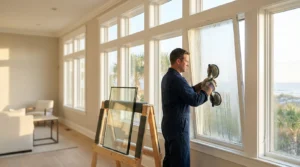
Most people call about glass replacement after something obvious happens. A window turns cloudy, a shower panel cracks, a mirror develops a dark creeping edge. The symptom is real, but it is rarely the whole story.
Good glass replacement begins by asking why the original glass failed. A window that fogged after six years failed differently than one that fogged after twenty, and repeating the same specification often guarantees a repeat failure.
That diagnosis matters even more along the Grand Strand. Salt aerosol, constant humidity, wind pressure, and intense UV exposure all shorten the life of sealants, spacers, coatings, and hardware finishes.
Signs Your Glass Needs Replacement Instead of Repair
Some conditions are cosmetic, others are structural or code related. Sorting them correctly keeps you from paying for a temporary patch on a permanent problem.
Foggy or Hazy Insulated Windows
An insulated glass unit, often called an IGU, is two panes sealed around a spacer, with a desiccant absorbing residual moisture and the cavity filled with air or argon. The perimeter seal is the component that ages.
When that seal fails, humid air enters, the desiccant saturates, and moisture condenses between the panes. The result is haze, streaking, or a permanent milky film.
This cannot be reversed. Defogging schemes may clear the appearance briefly, but the gas fill is gone and the original thermal performance does not come back. Replacing the unit is the honest answer, and in many cases the frame and sash stay in place.
Cracks, Chips, and Edge Damage
A crack in tempered glass is not cosmetic. Tempered panels carry engineered internal stress, and a crack means that balance has been compromised. Edge chips deserve the same urgency, since stress concentrates at the edge and a chipped shower door or glass guard can fail suddenly weeks later.
Signs that point clearly toward replacement:
- Haze, moisture, or mineral streaking trapped between panes of an insulated unit
- Any crack, chip, or nick on the edge of a tempered panel
- Delamination or spreading cloudiness inside a laminated glass panel
- Glass in a door, shower, or guard with no safety glazing mark
- Black edge creeping inward on a mirror
- Persistent drafts or room-side condensation despite intact glass
When the Problem Is the Frame or Hardware
Sometimes the glass is fine and the assembly is not. A sagging shower door usually means worn hinges, and a leaking window often means failed sealant or blocked weep holes rather than a bad pane.
A competent glazier checks the frame, drainage path, and fasteners before recommending new glass. Property owners scheduling Glass Replacement in Conway, SC frequently discover during assessment that the real failure sits in the frame or sealant, which shrinks the scope in their favor.
Repair or Replace: A Direct Comparison
| Condition | Recommended Path | Why |
|---|---|---|
| Fogged insulated unit | Replace the unit | Seal failure is permanent, performance cannot be restored |
| Cracked tempered panel | Replace | Tempered glass cannot be repaired |
| Edge chip on tempered glass | Replace | Edge damage risks sudden failure |
| Shallow scratch on annealed glass | Often repairable | Polishing can reduce surface scratches |
| Loose or sagging hinge | Repair | Hardware swap, glass unaffected |
| Deteriorated sealant joint | Repair | Cut out, clean, and reseal |
| Delaminating laminated glass | Replace | Interlayer separation is irreversible |
| Blocked weep holes causing leaks | Repair | Drainage issue, not glass failure |
Choosing the Right Glass for Replacement
Replacement is an opportunity, not an obligation to repeat what failed. Tempered glass is roughly four to five times stronger than annealed glass and breaks into small dull fragments, which is why it is required in showers, doors, railings, and near walking surfaces.
Laminated glass bonds plies to a PVB interlayer that holds fragments after breakage, resists penetration, dampens sound, and blocks most UV. It anchors impact-resistant glazing for coastal wind zones. Low-E coatings reduce solar heat gain, which in a cooling climate often matters more than U-factor, and low-iron glass removes the green edge tint on frameless enclosures.
| Glass Type | Best Replacement Use | Key Benefit | Field Cuttable |
|---|---|---|---|
| Annealed | Cabinet doors, decorative panels | Easy fabrication | Yes |
| Tempered | Showers, doors, railings, tabletops | Strength, safe break pattern | No |
| Laminated | Impact zones, sound control, security | Fragment retention, UV blocking | No |
| Insulated Unit | Windows, storefronts | Thermal separation | No |
| Low-Iron | Frameless enclosures, display glass | Near-colorless clarity | No |
One upgrade note: since the labor is already committed, replacement is the efficient moment to move to impact-rated glass or marine-grade hardware built on 316 stainless steel, rather than revisiting it later.
How the Glass Replacement Process Works
The visible work takes hours. The full process usually spans two to four weeks, and most of the quality is decided before new glass arrives.
Assessment and Field Measuring
The first visit identifies what failed and why, checking frame condition, substrate, and drainage. Then comes field measuring, where a professional measures at multiple points and records plumb and level deviation instead of assuming a rectangle.
That rigor is absolute for one reason. Tempered glass cannot be cut, drilled, or notched after tempering, so every dimension is final at fabrication. Non-rectangular work gets a physical template instead of numbers.
Fabrication, Removal, and Installation
Cutting, edge work, drilling, and tempering happen in sequence at a fabrication facility, and lead time depends on coatings, cutouts, and glass availability. Removal is the risky phase, damaged panels need containment, and old sealant must come out completely because new silicone sealant will not bond to cured old sealant.
The opening is then cleaned, setting blocks positioned, anchors verified, and the new glass set and aligned. Hardware gets torqued appropriately, never overtightened.
Sealing and Cure Time
Sealant goes only where it belongs, and joints designed to drain stay deliberately open so water escapes instead of collecting inside the assembly. Cure time is not optional, using a shower before the sealant cures compromises adhesion in exactly the joints that keep water out of the wall.
| Phase | Typical Duration | What Drives It |
|---|---|---|
| Assessment and measure | One to two visits | Failure complexity, geometry |
| Fabrication and tempering | Several business days | Coatings, cutouts, availability |
| Removal and installation | Hours to a full day | Panel count, access, substrate |
| Sealant cure | Product-specific period | Chemistry, humidity, joint depth |
What Coastal Conditions Do to Replacement Glass
Glass fails faster near the ocean, and it fails in predictable ways. Airborne salt settles on hardware and drives pitting and galvanic corrosion, which is why marine-grade materials and PVD finishes outlast standard plated zinc alloy here.
Thermal cycling works the perimeter seal on every hot afternoon and sudden thunderstorm, while UV intensity degrades sealants and lower-grade interlayers. Wind adds the storm dimension, design pressure ratings cover sustained pressure and impact ratings cover windborne debris, and they are separate qualifications.
Exposure varies across the region. Homes requesting Glass Replacement in North Myrtle Beach, SC or Glass Replacement in Surfside Beach, SC face the most aggressive salt exposure, while properties inland toward Glass Replacement in Marion, SC deal more with humidity and thermal cycling than with salt.
Safety Glazing Rules That Apply When You Replace
Replacement triggers current code, not the code in force when the building was constructed. ANSI Z97.1 and CPSC 16 CFR 1201 define the impact standards, and the building codes define hazardous locations where safety glazing is mandatory, including doors, sidelites, wet areas near tubs and showers, guards, and large panels near floor level.
Every compliant panel carries a permanent mark identifying the fabricator and standard, and that mark cannot be added later. Permits depend on scope, unit swaps often need none, while altering an opening or replacing a structural guard usually does, and coastal jurisdictions may require product approval documentation for rated assemblies.
Documentation expectations also vary by municipality. Owners scheduling Glass Replacement in Georgetown, SC or Glass Replacement in Little River, SC can face different review practices than owners a few miles away, so confirming before fabrication avoids expensive corrections.
How to Choose a Glass Replacement Company
A few questions sort the trade out quickly:
- Are you licensed and insured for this work, with current documentation available?
- What caused the original failure, and how does your specification address it?
- Which glass type, thickness, and hardware finish are you proposing, and why for this exposure?
- Will the glass carry a permanent safety glazing mark where required?
- What does the warranty cover, and how long is the sealant cure period?
Warning signs include firm quotes without a field measure, vague answers about thickness or hardware brand, no discussion of why the original failed, and pressure to skip permits. Local experience carries real weight too, a crew that regularly handles Glass Replacement in Murrells Inlet, SC and Glass Replacement in Garden City, SC already knows how local inspection practice and salt exposure shape the specification.
Caring for Newly Replaced Glass
Use a pH-neutral cleaner with microfiber or a squeegee, and avoid abrasives on coated glass. Hard water is the main enemy, minerals left to bond will eventually etch the surface permanently, and etching is damage, not dirt.
| Task | Frequency | Note |
|---|---|---|
| Squeegee shower glass | After each use | Most effective single habit |
| Full cleaning | Weekly | pH-neutral cleaner |
| Hardware inspection | Every few months | Check looseness and corrosion |
| Fresh water rinse, exterior hardware | Monthly, more oceanfront | Removes salt film |
| Sealant joint inspection | Twice yearly | Watch for shrinkage and gaps |
Frequently Asked Questions About Glass Replacement
Can a foggy window be fixed without replacing the glass?
No, not in a way that restores performance. The seal has failed and the gas fill is gone, so replacing the insulated unit is the appropriate remedy.
Do I have to replace the whole window or just the glass?
Often just the glass. If the frame and sash are sound and operate correctly, the insulated unit can be replaced while the frame stays.
Can tempered glass be cut down to fit?
No. Tempered glass is fabricated to final dimensions and shatters if modified, which is why careful field measuring matters so much.
Does glass replacement require a permit?
Unit swaps often do not. Altering an opening, replacing a structural guard, or modifying a commercial entrance typically does, and coastal jurisdictions may require rated assembly documentation.
How long does replacement take from call to finish?
Usually two to four weeks, with fabrication accounting for most of that. The installation itself runs hours to a day.
Should I upgrade the glass type while replacing?
Frequently yes. With labor already committed, moving to impact-rated, laminated, or coated glass now is more efficient than doing it later.
Conclusion: Replacement Works Best When It Fixes the Cause
Glass replacement is straightforward when the diagnosis is right and disciplined when the execution is right. The panel is one part of an assembly that includes frame, hardware, sealant, and drainage, and the specification has to match the exposure.
Along coastal South Carolina, that bar sits higher than inland. Diagnose carefully, specify deliberately, measure precisely because tempered glass allows no adjustment, and respect cure times. Done that way, replacement fixes the cause and not just the symptom.
Ready to Replace Your Glass? Talk With Southern Glass Pros
If you have foggy windows, a cracked panel, or glass that is not performing, an experienced glazier can tell you quickly whether replacement is the right call and what specification fits your exposure.
Southern Glass Pros serves Myrtle Beach and the surrounding Grand Strand region, with coastal conditions built into every specification. Call to describe your situation and schedule an assessment:
You can also reach the team through the contact page to share photos of the damage and request a callback.
Glass Replacement Services in Communities Across South Carolina
Replacement requirements shift from one community to the next. Salt exposure, wind zone classification, and municipal review practices all vary, and those differences change which glass, hardware, and sealant belong in the assembly.
Southern Glass Pros maintains dedicated pages for each community served. If your property sits in one of the locations below, follow the link to learn more:
- Glass Replacement in Lake View, SC
- Glass Replacement in Aynor, SC
- Glass Replacement in Briarcliffe Acres, SC
- Glass Replacement in Carolina Forest, SC
- Glass Replacement in Conway, SC
- Glass Replacement in Florence, SC
- Glass Replacement in Garden City, SC
- Glass Replacement in Georgetown, SC
- Glass Replacement in Little River, SC
- Glass Replacement in Longs, SC
- Glass Replacement in Loris, SC
- Glass Replacement in Marion, SC
- Glass Replacement in Mullins, SC
- Glass Replacement in Murrells Inlet, SC
- Glass Replacement in Nichols, SC
- Glass Replacement in North Myrtle Beach, SC
- Glass Replacement in Pawleys Island, SC
- Glass Replacement in Socastee, SC
- Glass Replacement in Surfside Beach, SC